How Nectar Parses Granular Utility Cost Data
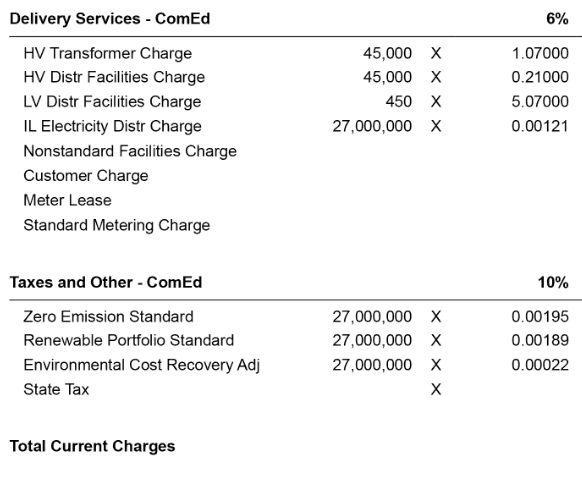
Utility bills look simple on the surface — a total amount due and a due date. But beneath that top-line number lies a complex structure of individual charges, each governed by different rate schedules, regulatory frameworks, and pricing mechanisms. For energy brokers, sustainability managers, and finance teams, understanding these line items is essential. The total tells you what you owe; the line items tell you *why* — and where the opportunities are.
Understanding utility bill line items
A typical commercial electricity bill contains several categories of charges:
- Supply (generation) charges — The cost of the electricity commodity itself, typically priced per kWh. In deregulated markets, this is the component that brokers negotiate with competitive suppliers.
- Delivery (distribution and transmission) charges — Fees charged by the local utility for transporting electricity from the grid to the facility. These include distribution infrastructure costs, transmission system charges, and various rider fees.
- Demand charges — Charges based on the peak power draw (measured in kW) during the billing period. Demand charges can represent 30–50% of a commercial customer's total bill, making them one of the highest-leverage areas for cost reduction.
- Taxes, surcharges, and assessments — Regulatory assessments, renewable energy mandates, public benefit charges, and applicable taxes. These vary significantly by jurisdiction and change frequently.
Natural gas, water, and waste bills follow similar patterns with their own charge categories — commodity costs, distribution fees, and regulatory surcharges — each requiring type-specific parsing logic.
The complexity of unit pricing
Beyond identifying the charge categories, accurate parsing requires handling the unit pricing embedded in each line item. A single bill might contain charges priced per kWh, per kW, per day, as a flat fee, on a tiered rate structure, or as a percentage of other charges. Time-of-use rates add further complexity, with different pricing for on-peak, off-peak, and shoulder periods. Getting the unit price right for each line item is what makes downstream analysis — rate comparisons, cost allocation, budget forecasting — trustworthy.
Why accurate parsing is difficult
Several factors make utility bill parsing a harder problem than it appears:
- Inconsistent formats — There is no universal standard for utility bill layout. Each of the 7,000+ utility providers in the United States uses its own bill format, terminology, and organization. A "delivery charge" on one bill might be called a "distribution service charge" on another, while a third splits it into multiple sub-line items.
- Variable units — Even within a single utility, different rate classes use different measurement units, billing determinants, and rate structures. Parsing logic must adapt to each combination.
- Complex rate structures — Tiered rates, time-of-use schedules, demand ratchets, power factor adjustments, and seasonal rate variations all affect how individual charges are calculated. Extracting these correctly requires understanding the rate structure, not just reading the numbers on the page.
- Frequent changes — Utilities update their rate schedules, bill formats, and line-item descriptions regularly. A parser that works today may produce errors next quarter if it cannot adapt to format changes.
The importance of automation
Manual line-item extraction is technically possible but does not scale. A single analyst might accurately parse a dozen bills per day with careful attention. An organization with hundreds of accounts across dozens of utilities generates thousands of bills per year — far beyond what manual processes can handle without introducing the errors and delays that undermine the data's value.
Automated parsing systems address this by combining document recognition, natural language processing, and utility-specific parsing rules to extract line items at scale. The best systems validate their output against expected ranges and flag anomalies for human review, creating a feedback loop that improves accuracy over time.
Benefits for energy broker teams
For energy brokers, granular cost data unlocks several capabilities that top-level billing data cannot support:
- Rate validation — Compare actual charges against contracted rates to detect billing errors and overcharges.
- Procurement analysis — Isolate supply costs from delivery costs to evaluate commodity pricing independently and build more accurate RFP specifications.
- Demand management — Identify facilities with disproportionately high demand charges and recommend load management strategies that reduce peak draw.
- Cost allocation — Break down utility costs by component for accurate tenant billing, departmental allocation, or project-level accounting.
- Regulatory tracking — Monitor changes in surcharges, assessments, and regulatory fees across jurisdictions to anticipate cost impacts for clients.
Conclusion
Granular utility cost data is the difference between knowing *what* you pay and understanding *why* you pay it. For organizations that need to optimize energy spend, validate billing accuracy, or report on cost drivers with confidence, line-item parsing is not optional — it is the foundation. Nectar's parsing engine extracts this detail from bills across 7,000+ utilities, delivering standardized, line-item data that teams can trust for procurement, analysis, and reporting. For energy brokers, this granularity is what drives measurable ROI — learn more in how energy brokers leverage accurate utility data.