Utility Bill Management and AI
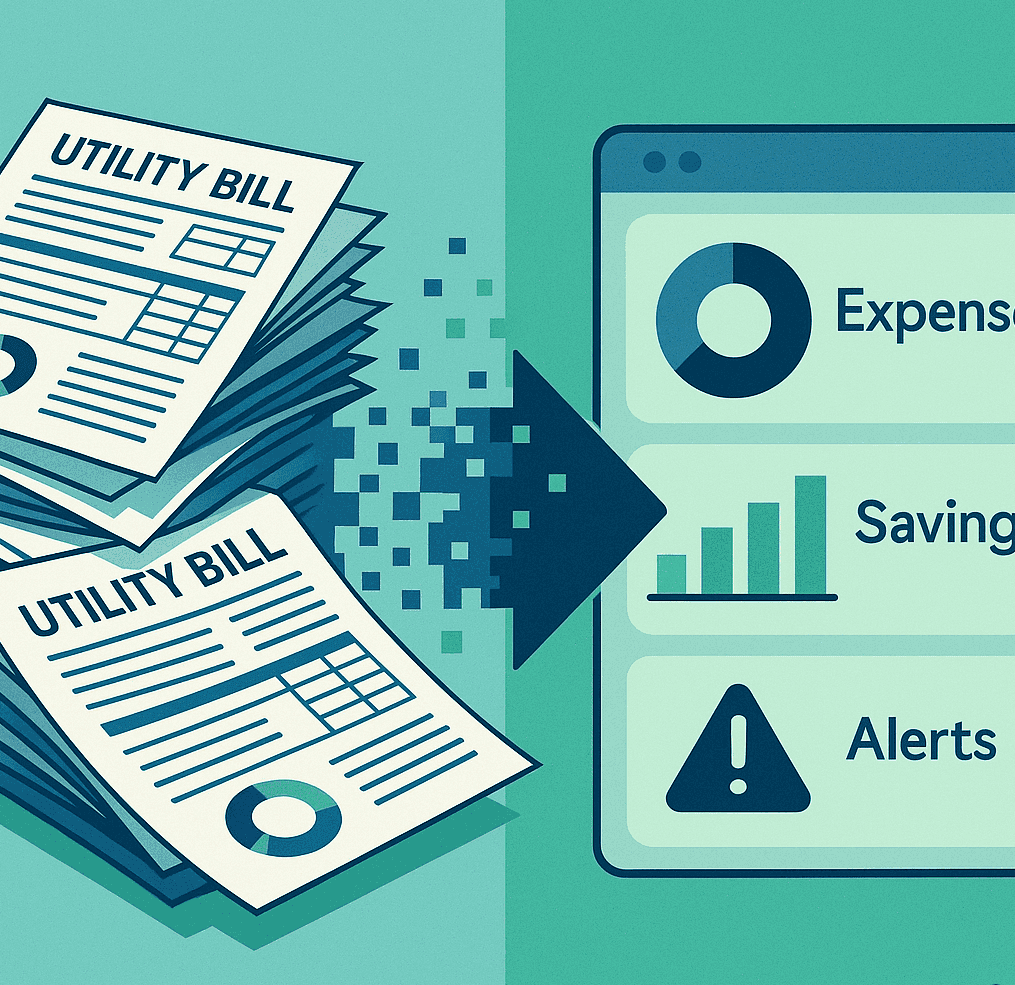
For organizations managing dozens or hundreds of facilities, utility bills represent one of the largest and most complex recurring expenses. Yet the processes used to manage them — manual downloads, spreadsheet tracking, email chains with AP teams — have barely evolved in decades. AI is changing that equation, turning utility bill management from a reactive administrative burden into a strategic capability.
Why utility bill management matters
Utility expenses are not just line items to pay and forget. They carry signals that affect three critical business functions:
- Bottom line — Energy costs are typically the second-largest operating expense for commercial buildings after labor. Even small inefficiencies — missed rate changes, billing errors, undetected demand spikes — compound across a large portfolio into significant unnecessary spend.
- Compliance — Regulatory frameworks like the SEC climate disclosure rules, CSRD in Europe, and local benchmarking ordinances require accurate, auditable utility consumption data. Organizations that cannot produce this data on demand face reporting delays and compliance risk.
- Data-driven decisions — Capital planning, sustainability target-setting, and efficiency investments all depend on reliable utility data. Without it, teams are making million-dollar decisions based on estimates and assumptions.
The challenges of manual management
Most organizations still manage utility bills through some combination of manual processes that introduce predictable failure modes:
- Fragmented data — Bills arrive from dozens of providers in different formats — PDF, paper, online portals with different login credentials. Information is scattered across email inboxes, shared drives, and individual desktops with no single source of truth.
- Human error — Manual data entry from bills into tracking systems introduces transcription errors. Research consistently shows error rates of 10% or higher in manual utility data processes. These errors propagate into budgets, sustainability reports, and procurement decisions.
- Slow processing — When bills must be manually downloaded, reviewed, coded, and entered before they can be analyzed, the lag between bill issuance and actionable insight can stretch to weeks or months. By the time an anomaly is detected, the opportunity to act on it may have passed.
How AI transforms utility bill management
AI-powered platforms address each of these failure modes by automating the end-to-end bill management lifecycle:
Automated data extraction
Modern AI parsing engines can read utility bills in any format — PDF, scanned images, electronic data interchange — and extract not just top-level totals but granular line items: supply charges, delivery charges, demand readings, taxes, and fees. This eliminates manual data entry and captures detail that human processes routinely miss.
Anomaly detection
Machine learning models trained on historical consumption patterns can flag bills that deviate from expected ranges — a sudden usage spike, an unexpected rate change, a demand charge that does not match the facility's load profile. These alerts surface problems in real time rather than during a quarterly review.
Cost optimization
With complete, accurate billing data flowing continuously, AI systems can identify optimization opportunities that are invisible in manual processes: rate structure mismatches, demand response eligibility, time-of-use arbitrage, and billing errors that warrant disputes with the utility provider.
Centralized management
A single platform that ingests bills from all providers across all sites creates the unified view that manual processes cannot achieve. Every stakeholder — from facilities managers to the CFO to the sustainability team — works from the same data, eliminating version conflicts and reconciliation overhead.
Best practices for implementation
Organizations adopting AI-powered utility bill management should consider several principles:
- Start with a centralized platform — Consolidate all utility data into a single system before layering on analytics. The value of AI depends on the completeness and quality of the underlying data.
- Integrate with AP and sustainability workflows — Utility bill data should flow into accounts payable for payment processing and into sustainability platforms for emissions reporting. Siloed systems create the same fragmentation problems that AI is meant to solve.
- Establish continuous monitoring — Move from periodic bill reviews to continuous monitoring. AI-powered anomaly detection only works when data flows in real time, not in monthly batches.
Nectar's approach
Nectar automates the full utility bill management pipeline — from data collection at the source through parsing, validation, and delivery into downstream systems. The platform connects directly to over 7,000 utility providers, handles credential management and two-factor authentication, and extracts line-item detail with 99%+ accuracy. For organizations ready to move beyond spreadsheets and manual processes, the shift to AI-powered bill management is not a future aspiration — it is available today. To understand the full value that utility data can unlock, read why utility bill data is a strategic asset.